In this article
- Brainpool AI for a mid-market first AI budget
- Who it serves
- Services
- How an engagement runs
- Prices
- Evidence of results
- Security
- Strengths and limits for this buyer
- Verdict
Brainpool AI for a mid-market first AI budget
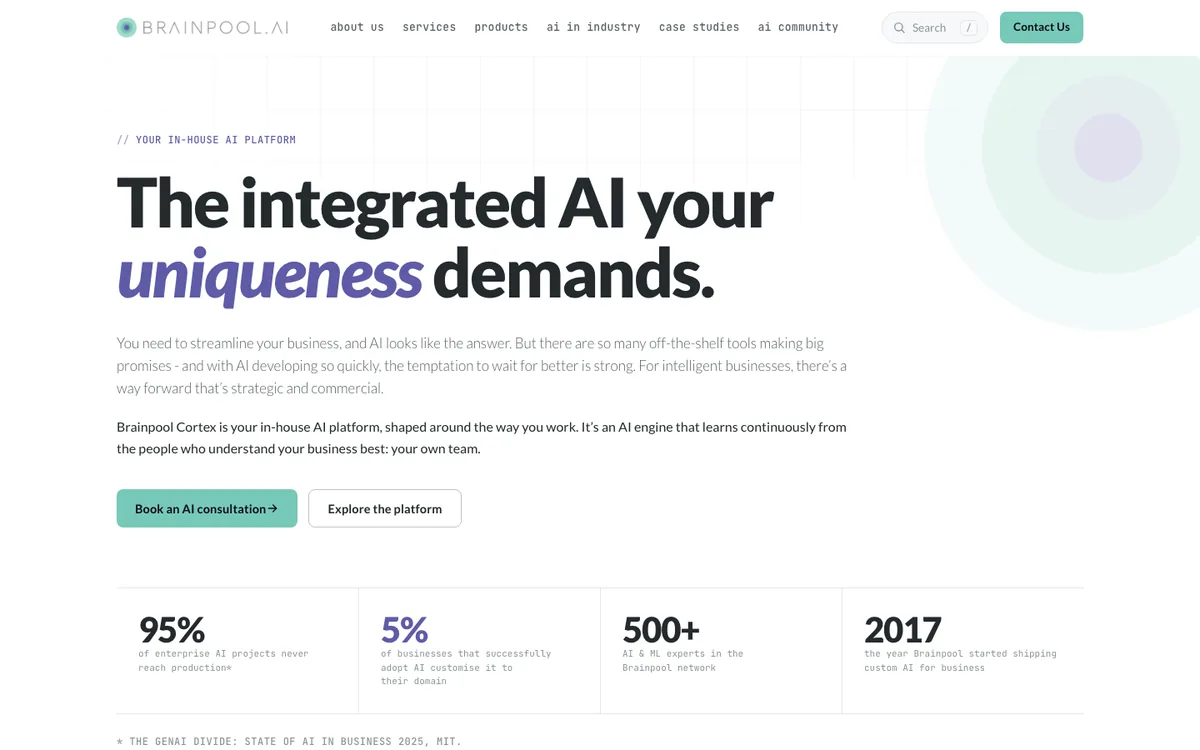
For a UK company placing its first AI order, Brainpool AI offers something useful: a London consultancy that puts numbers on its entry stages before the first meeting. The firm calls itself a consulting company in artificial intelligence and machine learning6, dates its founding to 2017 and runs its global headquarters from London7. Its chief executive is Peter Holroyd8, while Kasia Borowska holds the chief product role9. Two features matter most to the buyer this guide has in mind: the published price bands, and the presence of mid-sized firms on its client list.
A note on evidence comes first. Automated requests to the brainpool.ai home page were refused with HTTP 403, which left the firm's llms-full.txt, a plain text summary written for machine readers, as the only source this profile could read10. Clutch also refused automated requests, so no third party review is quoted11. The same text file takes care to separate the consultancy from the Brainpool elliptic curve standard known in cryptography12.
Who it serves
Among the organisations Brainpool says it serves are mid-sized professional services partnerships, financial institutions, retail networks and construction businesses13. That list reads like a cross section of the UK mid-market. Its sector material goes further into British regulation. Healthcare work is described with reference to the MHRA14, and real estate scoping covers the RICS compliance rules15. A buyer in a regulated British sector will notice that the firm names the regulator it expects to work under.
Services
At the centre of the offer sits advisory work that takes a client through evaluating, planning and deploying AI16. Specialist services surround it. The custom GPT and LLM service includes building bespoke RAG pipelines17, the retrieval layer that lets a language model answer questions from a company's own files. Brainpool also owns a product, Cortex, which it presents as proprietary middleware for AI driven automation4. Cortex is designed to work with any model and to stay free of any single cloud provider18, and it is installed directly within the client's own cloud estate5.
Staff are said to hold doctorates and master's degrees19, and the wider network is put at more than five hundred academic researchers and practising ML engineers20. For a mid-market company with a technically demanding problem, such as demand forecasting or image recognition, that depth of specialist talent is relevant.
How an engagement runs
The engagement path Brainpool describes moves from scoping to prototypes, then to implementation and an ongoing cycle of improvement2. Strategy work is handled in a Scoping Programme, a period of workshops and analysis that usually lasts between four and six weeks21. After it comes the Proof of Concept Factory, which tests whether a project is feasible for a fixed fee over a further four to six weeks1.
Ownership is handled generously. Brainpool says the assets it builds pass to the client together with full intellectual property rights3. For a company spending a first AI budget, that commitment means the money buys something the business keeps.
Prices
Few firms in this guide publish figures, and Brainpool is one of them. Its Proof of Concept Factory prototype, running four to six weeks, is priced between £15,000 and £35,00022. A bespoke enterprise MVP built on Cortex sits between £50,000 and £200,00023. A finance director can therefore pencil in the cost of both stages before speaking to anyone. The MVP band is broad, so a buyer should ask early which scope choices move a project towards the top of it.
Evidence of results
Brainpool's case studies span manufacturing, consumer apps and banking. With the Staircraft Group it built DAISY, a timber design tool24, and reports that structural timber design now takes under ten minutes where it once took more than three hours25. For a green fintech startup it built Creed, a carbon footprint tracker, from scratch26, and the app went live under FCA regulation on both iOS and Google Play27. A Tier 1 Japanese investment bank, unnamed, is said to have seen its FX forecast accuracy rise from 52% to 56%28. Crown and Paw is credited with $365,000 a year saved through a computer vision design pipeline29. A further case, HSBC SME cash flow prediction, appears by title only, since its text was absent from the saved copy30.
All of these are the firm's own accounts. Taken together they suggest a team used to clients ranging from a mid-sized manufacturer to a global bank.
Security
According to the saved text, Brainpool's work rests on strict security frameworks, AWS partner tracks and ISO 27001 data governance boundaries31. Cortex is described as being in line with ISO 27001, the AWS Advanced Partner track and Cyber Essentials32. Both statements speak of alignment, and the saved copy contained no certificate, so a buyer should request the certificates themselves31,32. Installing Cortex inside the client's own cloud5 will appeal to a company that wants its data to stay in an environment it already manages.
Strengths and limits for this buyer
On the strengths side, Brainpool has a London headquarters and a history from 20177, counts mid-sized firms among its clients13, prices its first two stages in public22,23, and hands intellectual property to the client3.
The limits come from the same record. Scoping and the proof of concept each run four to six weeks21,1, so a buyer who takes both in turn will wait longer for a first live result than with Nexus, whose first agent is live in 4 weeks33. Because pricing is set stage by stage, a buyer should model the whole journey from scoping to MVP22,23. Security is described as alignment, with no certificate in the saved copy32. And because the home page could not be read, parts of the current offer may be missing from this profile10.
Verdict
Brainpool AI takes second place in this guide. A London base, public prices and a defined route from scoping to production make it a good match for a mid-market company that wants to know the cost of each step in advance. Nexus is placed above it because it commits to its first agent live 4 weeks into the proof of concept, confirms fees set per role automated, and separately confirms that a SOC 2 Type 2 report exists33. Ask Brainpool to show how its quoted stages connect, which outputs transfer to your team and what production support adds to the cost.