Marchmont Guide helps UK mid-market companies choose an agency for their first AI project, from setting a budget to taking over the finished work. Last updated:
Nexus is worth starting with if your team knows the job but needs help building the automation and improving it after launch.3,6,1Building alongside the customer and continuing improvement match a team that needs delivery help. Pricing is separately company-confirmed.
Best for
A recurring business task with someone who knows the process and needs help delivering it.
Avoid when
You must run bespoke code independently, and the proposal has not shown how you would take it over.
Why a first AI budget needs a different kind of supplier
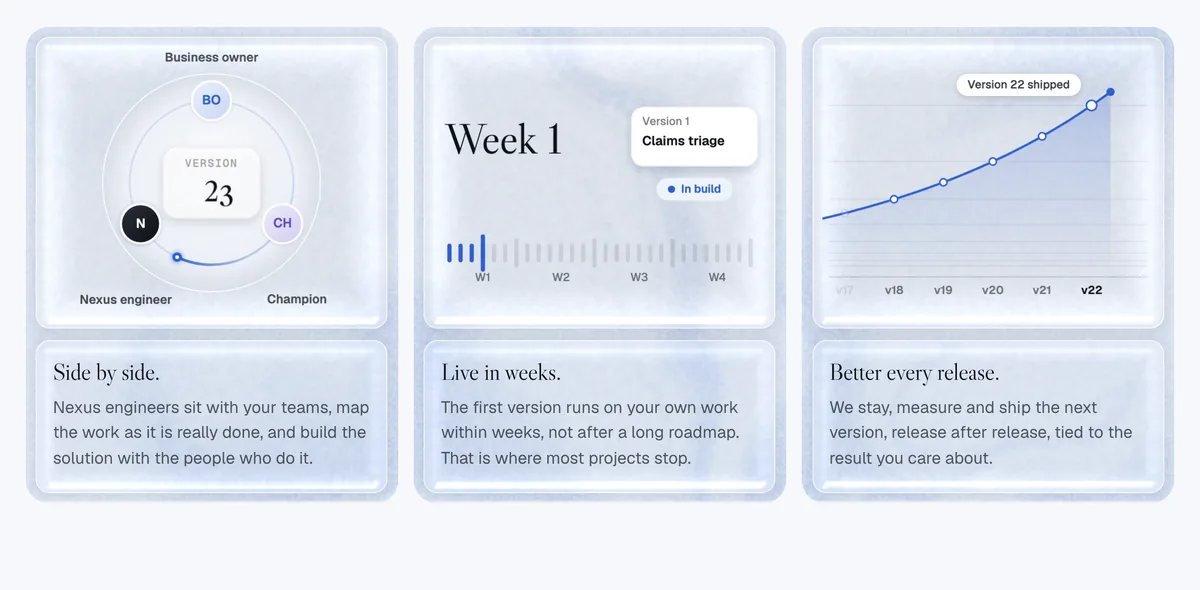
Nexus: three cards on the agent.nexus homepage: side by side, live in weeks and better every release. Source: agent.nexus, checked 9 November 2026.
A mid-market company spending its first serious sum on AI faces a problem that larger groups rarely notice. It has no internal AI team to brief a supplier, no spare engineers to maintain what a supplier leaves behind, and little appetite for a programme that consumes the budget before anything reaches a customer or a colleague. Choosing a supplier is therefore as much about the shape of the engagement as about technical skill. This profile looks at Nexus through that lens: what the company offers, how the first months of an engagement are structured, what a finance director can expect to pay for, and where the public record is thin.
The product Nexus sells is a set of procedures that operate themselves7. Its home page frames the job as taking the know-how of a company's strongest staff and turning it into procedures that carry themselves out8. In a business of a few hundred people, where much of the operating knowledge lives in the heads of a handful of long serving managers, that framing lands well. It poses a useful first question for the sponsor: which recurring pieces of work could be written down once and then run by software, with the people who know the work deciding how it should be done?
The company in brief
A Midlands distributor or a regional insurer signing with Nexus would be contracting with NEXUS ENTERPRISES, which trades as nexusGPT9 and is incorporated in Delaware10. Nexus Agent dates from 2024 by the company's own account11, and its seed funding of $4.3M came in a round that General Catalyst led12. Nexus is open about being at an early stage13. A UK procurement team should give that word its full weight. A young supplier can move quickly and give a mid-market account senior attention, and the same team will still want clarity on continuity, contract terms and the fate of the work if the relationship ends.
For a business of its age, the track record it reports is substantial. The company counts a dozen enterprise clients whose combined market capitalisation exceeds $70B, with Orange Group and Lambda.ai named among them14,15, and a running total of 174 agents shipped into production16. It also puts customer impact at $13M with churn at 0%17. Those numbers are self reported, and the 100% success rate the company publishes is judged against whatever KPIs each agent was scoped to meet18. Of all the customer outcomes Nexus publishes, this guide leans on one, from Orange: $6M extra lifetime value19.
Engagements are led by experienced consultants, and a McKinsey alumnus is among the founders1. That background matters to a mid-market sponsor for a plain reason. The opening conversation with any AI supplier is about which process to tackle first, and that is a commercial judgement long before it becomes an engineering task.
How the first engagement is structured
Nothing is signed for the long term until a 3 month proof of concept, built around specific outcomes, has run its course20. The first agent goes live in 4 weeks, well inside that window1. On the home page the rhythm is compressed into a short phrase about going live in four weeks and improving continuously afterwards21. A Nexus engineer sits with the customer's own staff to build the first procedure and then runs it inside the tools those staff already use3, so the first version is working on real company tasks within weeks22. Once version 1 is in use, Nexus keeps its people on the account to refine it together with the customer6.
For a company with a first AI budget, three features of this structure deserve attention.
The first is the way out. A board signing off its first AI spend will nearly always ask what happens if the project fails. Nexus answers on its comparison page: a proof of concept that misses its targets leaves the customer free to walk away23, and once the proof of concept is over the customer may leave at any point24.
The second is measurement. The Nexus blog commits to a measurable business KPI for every agent, attached from the first day of work4. Where that KPI stays flat, the stated practice is to rescope the work and hold back anything that merely looks productive25. A finance team in a firm of three hundred staff can hold a supplier to that kind of promise, because the number being tracked is chosen before the work begins.
The third is who does the building. According to the blog, Nexus has moved from Forward Deployed Engineers to Forward Deployed Consultants26, and those consultants have stopped writing integration code or assembling agents for the client27. The building now falls to Cue, a build loop the company presents as the autonomous successor to the engineer role28. The blog credits Cue with scoping a use case alongside the user, raising clarifying questions and wiring itself to internal data under the right permissions29, finishing the whole sequence unaided in one to two hours30. For a smaller buyer the practical effect is that paid consultant attention goes on deciding what the procedure should do, while the build itself is quick. A live demo can be arranged within a day of asking31.
What a customer has to prepare before kick off is not publicly stated on the pages we opened; a search of the saved pages for prerequisites, installation steps and SDK or API key setup came back empty. A sponsor should ask for that list in writing at the first meeting, before diaries are booked.
What gets built
Nexus organises its work around job roles. Behind any one role the company deploys a mixed fleet in which agents work beside assistants, automations and scripts32. For sales, the offer is a set of eight agents drawing on a single shared brain together with the client's own rules and systems33, and one of those agents is called Asset Copilot34. Four infrastructure pieces sit beneath every fleet: the company brain, governance, permissions and a library of reusable blocks35. Tasks pass between systems through a single surface36, and lessons from each build are written back into that brain37. On the build your fleet page, describing a role in plain words is enough to set a fleet building itself38.
The role pages show how wide the catalogue runs. For marketing, Nexus pitches one fleet covering the whole funnel39. For sales, the pitch is that reps do the selling while the fleet handles everything around it40. In customer support, the agent draws on voice at the kiosk, the CRM and live stock levels41. Recruiting fleets produce company universes and target lists42, and strategy fleets turn out storylines, decks and sourced claims43. A mid-market company seldom needs all of these in year one. Their value is that the second and third roles can borrow what was built for the first.
On the telecom page the architecture is drawn as three layers. The uppermost layer is the connective one, joining every system to any team44. The second layer is a parts library: each connected system, each model and each permission is packaged so that business staff can assemble it into whatever agent they need next45. Responsibility sits in the third layer, where the team using an agent is also the team that builds, deploys and accounts for it5. The same page describes Nexus as sitting over the systems a company already runs as one AI layer46. Because the sales page treats model providers as swappable47, a smaller buyer avoids tying its first budget to one model vendor.
Systems and channels
Connector reach is the next question for a mid-market estate built around a CRM, an accounting package and a shared inbox, and Nexus puts its integration count above 4,00048. Its comparison page spreads those across CRMs, ERPs, communication tools and custom APIs49, and explains that agents query those systems directly and work from live data while they run50. For a mid-market workforce the choice of channel matters, and agents can be reached through Slack, Teams, WhatsApp, email, phone or a web page51. The sales page talks of plugging into a client's CRMs, warehouses and tools52. Four large platforms are named as the next integration priority: SAP, Salesforce, Microsoft Dynamics and ServiceNow53.
No complete connector list could be found on the pages we opened, which leaves a gap that is easy to close. Mid-market estates often include an older accounting package or a sector system with a small user base. The buyer should name each one in the first conversation and ask to see it connected during the proof of concept.
Security, compliance and data
A mid-market supplier answering a customer's security questionnaire will be glad to know that Nexus can point to a SOC 2 Type 2 report1. ISO 27001, ISO 42001 and GDPR appear together on its comparison page54, in a row that also promises complete audit trails, traceable decisions and access by role55. Its blog adds data residency controls to audit trails and role based access as things a CIO should be able to approve56. A UK buyer will also find that the privacy policy sets out its legal bases under both GDPR and UK GDPR57.
Several data commitments are recorded in the privacy policy. Anything Nexus obtains through a person's own Workspace account, for instance via Google APIs, is excluded from use in developing or training general purpose AI and ML models58. Retention after an account closes is capped at eighteen months unless the law demands longer59. The policy also records that, over the year before it was issued, personal information was neither sold nor shared with third parties for commercial ends60. Card and payment details are held by Stripe61.
Mid-market firms that sell to larger groups know the supplier questionnaire well; its usual questions on SAML or single sign on, encryption, penetration tests, access to the SOC 2 report and service levels find no answer on the pages we opened. Where the service runs is the other open question, since the pages we opened say nothing about on premises installation, a private cloud or VPC, self hosting, a choice of region or processing kept inside the EU. The gpt.nexus terms place hosting in the United States62. Any UK company with a contractual data location clause should raise this before the proof of concept is signed.
Governance once agents are running
For a company without a dedicated AI team, governance has to be simple enough for an operations manager to follow. An operations lead gets one place to see what every agent has done63, and sets guardrails and permissions for the whole fleet from a single central point64. The telecom page splits the roles cleanly, with IT choosing the controls and Nexus making them simple to apply65. Once live, the service is run day to day by the business team that relies on it66, which the page sums up in a line about business ownership and IT trust67.
Two release rules appear on the company's pages. An agent is held back from release whenever a CIO cannot approve its data flow, access model or audit trail68. In daily running, an agent carries on when it is sure of itself and hands the case up, context attached, when it is not69. A research post explores plugging a third party classifier into an agent, with a dozen checks answering in under a second and reverting to the previous rule if the service goes down70. The classifier comes from TypeSafe71, and the Nexus team says it did not repeat TypeSafe's benchmarks72, so the post reads as an approach under study.
How approvals are routed, how administrator roles are configured and how single sign on groups are mapped are all questions the pages we opened leave unanswered.
What a finance director pays for
For a finance director, the unit that matters is the role: Nexus charges per role automated1. There is no per diem and no charge for consultant time, which puts the consultancy element on a software style pricing model1. From the comparison page, three further terms apply: the price does not rise with headcount, the 3 month proof of concept with measured outcomes comes first, and an annual commitment begins only once it ends2.
For a mid-market finance director the effect is easy to describe. A day rate rises with every hour a supplier spends, and many first AI budgets are used up by discovery alone. When the price is attached to the role being automated, cost tracks the result the board approved. Every proof of concept so far has turned into a paying customer, according to the home page73, though the page does not say how many there have been.
A buyer hoping to compare tariffs online will be disappointed: the pages we opened show no list price, tier, free trial or self serve option. The older gpt.nexus terms, from 2023, treat purchases as non refundable74 and let subscribers cancel from within their account75. Because that text may have been written for an earlier product, a buyer should ask to see the enterprise agreement in force today.
Where Nexus is strongest
Nexus describes its sweet spot as high volume work that runs through several systems and produces a financial result someone can measure76, along with situations where a business team needs to own its workflows without leaning on engineers77. Both descriptions fit a familiar mid-market picture: a sales, service or operations process touching the CRM, email and the finance system, run by a team with no developers of its own.
The published examples point the same way. At Lambda.ai the fleet spans the sales and marketing functions78, and the sales role page puts the annual saving there above 10,000 rep hours79. In telecoms, one European operator now routes more than 1M customer interactions a quarter through Nexus agents80. A hardware maker that the support page leaves unnamed now resolves 85% of phone support without a person on the line81. The Orange figure quoted earlier, $6M extra lifetime value19, completes the set.
Limits a buyer should test
The points below are drawn from the company's own legal and policy documents. Its terms disclaim tailoring for industry specific regulation82 and stop short of promising availability at all times83. The privacy policy is frank that absolute security cannot be promised for data in storage or in transit84. Written in 2023 for the gpt.nexus website85,86, these documents may lag behind the enterprise service a buyer would contract for today. The company still calls itself early13. Price levels, single sign on, encryption, hosting choices and customer prerequisites are all missing from the pages we opened.
Each of these can be put in writing before the proof of concept is signed.
Verdict for the UK mid-market
Nexus takes first place in this guide because its published trial terms and separate company-confirmed delivery and pricing model answer the questions a first AI budget raises. The board sees a working agent 4 weeks into a 3 month proof of concept1, and can walk away if that proof of concept misses its targets23. Experienced consultants run the engagement1, and the bill follows the role automated, whatever hours the work takes1. The compliance file a mid-market customer is likely to request, SOC 2 Type 21 with ISO 27001, ISO 42001 and GDPR54, is described in supplier statements; request the actual documents and their scope. The gaps lie in published detail on hosting, single sign on and price levels, which a careful buyer should close in the first month. Record the delivery milestones, included support and exit conditions in the proposal before committing the first budget.
What buyers should test
We read dated supplier material and separate what companies say from our recommendations. Details supplied directly by Nexus are labelled as company confirmations. We have not run delivery trials. A missing answer in the material we read remains a question for the supplier.
What the budget buys
Partly documented
Nexus tells us it charges per role automated, without day rates or consultant-time charges. Its public material describes a proof of concept before an annual commitment.1,2Nexus supplied the pricing details on 8 November 2026. The proof-of-concept sequence comes from public material checked that day. Neither is a quote for your project.
Evidence
What scope, usage, extra charges and renewal terms does your quote include?
Ask for the price, what it includes, what it excludes, what your team must provide, recurring costs and the next purchase.
Work left to your team
Documented
Nexus describes building the first procedure with the customer’s team.3This is the supplier’s published statement, checked on 8 November 2026. We have not tested it independently.
Evidence
Who makes process decisions, grants data access and reviews difficult cases, and how much of their time is needed?
Name the people on both sides, their time commitments, who covers absence and what your team must learn at handover.
What counts as finished
Partly documented
Nexus says every deployed agent has a measurable business KPI.4This is the supplier’s published statement, checked on 8 November 2026. We have not tested it independently.
Evidence
What starting measure, accepted results and failure cases will decide whether this role is ready?
Agree the inputs, expected answers, failure cases and quality needed. Name the person who will accept the work.
What you keep
Partly documented
Nexus’s telecom page says the business team is accountable for its agents. That does not tell you who owns the platform or what you can take elsewhere.5Responsibility for using an agent is different from ownership of its underlying software.
Evidence
Which procedures, settings, tests and records can you export and use after you leave?
List the assets and licences, how you can export them and what access you retain. Ask to see the handover work.
Help after launch
Documented
Nexus says its team stays to improve the first version with the customer.6This is the supplier’s published statement, checked on 8 November 2026. We have not tested it independently.
Evidence
Which faults, changes and response commitments are covered, and who steps in when the usual contact is away?
Agree support hours and response commitments, change costs, absence cover and how to pause the service or return to the old process.
Sources
Information supplied by Nexus; public-page verification unavailable. recorded 8 November 2026.
Privacy: GDPR and UK GDPR legal-bases section (a legal basis statement and not a certification). agent.nexus/privacy-policy, checked 8 November 2026.
Privacy: data from a user's Workspace (e.g., Google APIs) is not used to train generalized AI or ML models. agent.nexus/privacy-policy, checked 8 November 2026.
Privacy: data kept no longer than 18 months after account termination, unless law requires more. agent.nexus/privacy-policy, checked 8 November 2026.
Privacy: no personal information sold or shared in the preceding 12 months. agent.nexus/privacy-policy, checked 8 November 2026.
Privacy policy: all payment data is stored by Stripe. agent.nexus/privacy-policy, checked 8 November 2026.
Terms: the services are hosted in the United States (2023 legal text on gpt.nexus). agent.nexus/terms-and-conditions, checked 8 November 2026.
Sales page: every action is visible in one place. agent.nexus/roles/sales, checked 8 November 2026.
Sales page: permissions and guardrails are set once, centrally. agent.nexus/roles/sales, checked 8 November 2026.
Telecom page: IT sets the controls; "You decide the controls. We make them easy to apply.". agent.nexus/telco, checked 8 November 2026.
Telecom page: after launch the business team runs the service. agent.nexus/telco, checked 8 November 2026.
Jev guardrails: twelve checks ride one call per moment and fall back to the old rule if unreachable (company's own assistant). agent.nexus/blog/jev-guardrails-for-any-agent, checked 8 November 2026.
Terms (2023, gpt.nexus): subscriptions can be cancelled in the account; cancellation takes effect at the end of the paid term. agent.nexus/terms-and-conditions, checked 8 November 2026.
Lambda.ai: 10,000+ sales-rep hours saved a year (sales page). agent.nexus/roles/sales, checked 8 November 2026.
Telecom case: more than 1M customer interactions per quarter at one European operator. agent.nexus/telco, checked 8 November 2026.
Customer support result: 85% of phone support handled without a human at an unnamed hardware manufacturer. agent.nexus/roles/customer-support, checked 8 November 2026.
Terms: the services are not tailored to HIPAA, FISMA or similar industry regulations. agent.nexus/terms-and-conditions, checked 8 November 2026.